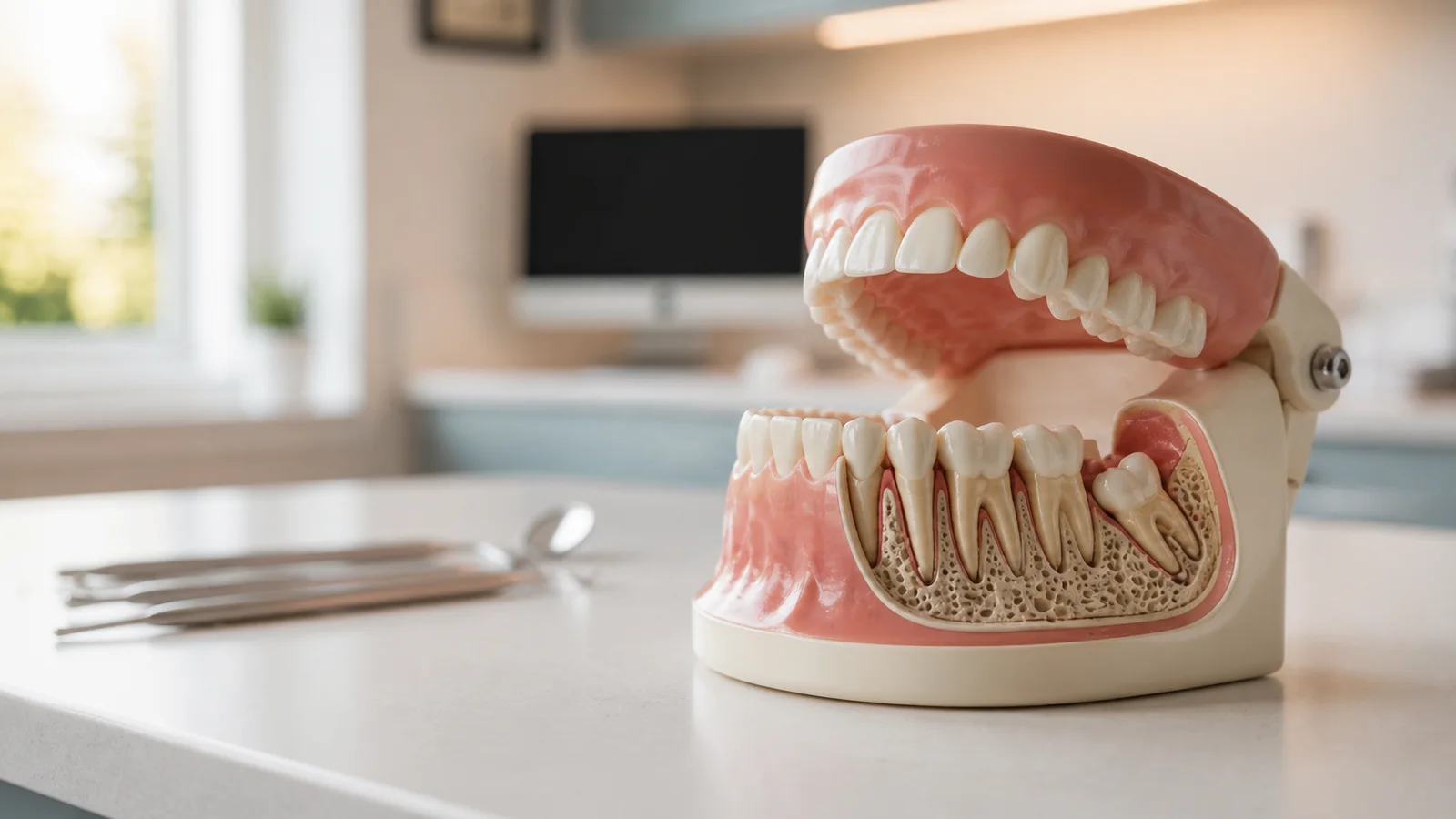
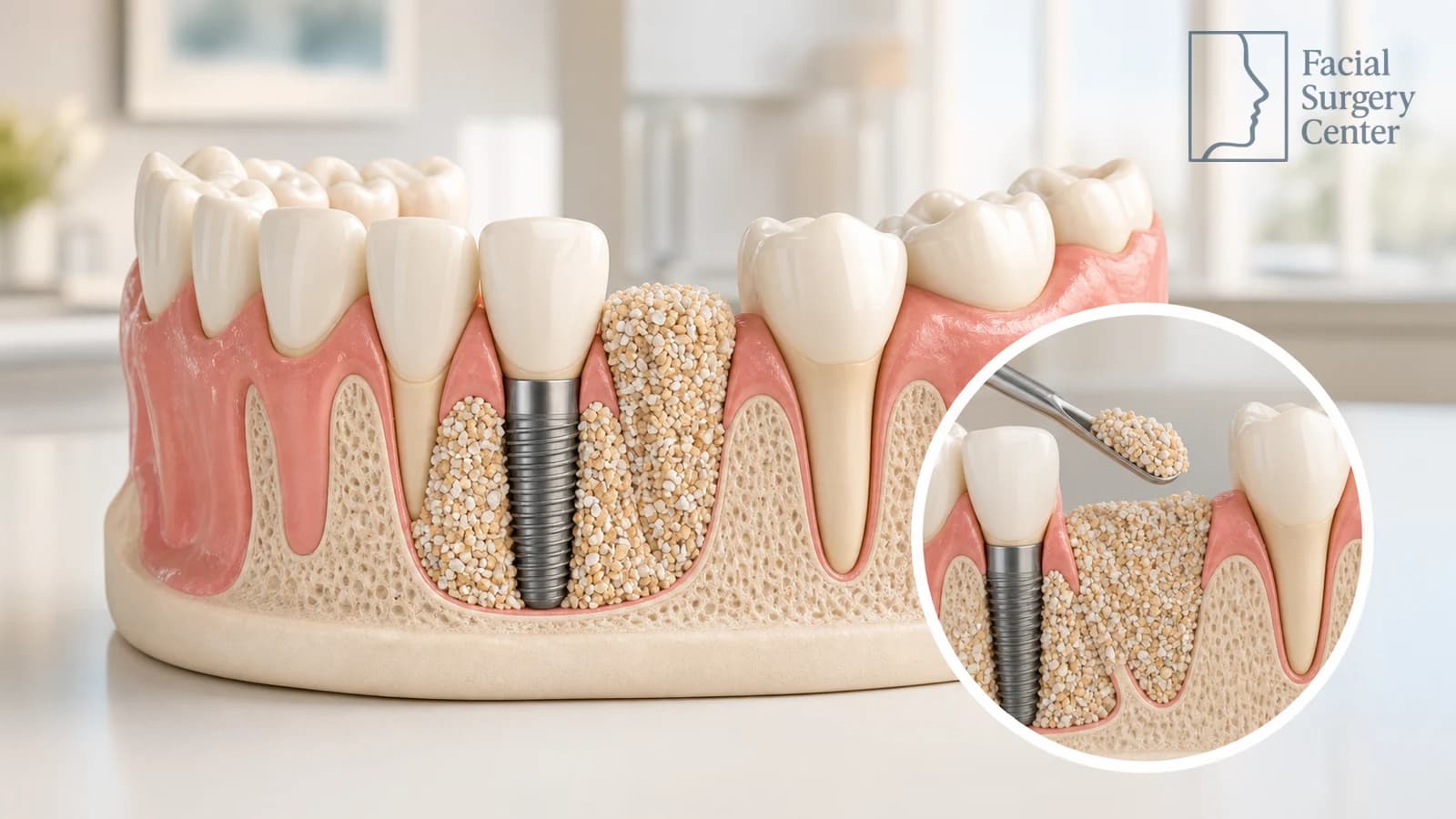
A dental bone graft adds material to an area of the jaw where bone is thin or missing. The material acts as a framework while your body builds new bone through and around it. Once the area has healed, the stronger jawbone may be able to support a dental implant.
That is the short answer to what is a dental bone graft. The part that causes confusion is the word “graft.” It does not always mean taking a large piece of bone from another part of your body. Many dental grafts use small particles from a screened donor, a processed animal source, or a synthetic material. The right choice depends on how much bone is missing and what the area needs to support.
What is a dental bone graft used for?
The most common reason is to create enough bone for a dental implant. An implant replaces a tooth root and needs stable jawbone around it. If the ridge is too narrow, too short, or too soft, placing an implant without rebuilding the area may not provide the support it needs.
Bone loss can happen for several reasons:
- A tooth has been missing for months or years. Jawbone naturally shrinks when it no longer receives stimulation from a tooth root.
- A tooth needs to be removed. A socket-preservation graft may help limit the collapse of the ridge after extraction.
- Gum disease or infection damaged the supporting bone. The diseased tissue must be treated before a stable reconstruction can be planned.
- Trauma, a cyst, or another condition removed bone. Grafting may be part of rebuilding the damaged area.
- The upper back jaw is close to the sinus. A sinus graft can create more vertical bone for an implant.
Not every missing tooth needs a graft. Some people already have enough healthy bone, and in selected cases the implant can be placed at the same appointment as a smaller graft. The decision comes from an examination and imaging, not from how the gums look from the outside.
What is a bone graft for teeth actually made of?
Dental bone graft material comes from four main sources. None is automatically best for every patient.
| Graft type | Source | Main consideration |
|---|---|---|
| Autograft | Your own bone, often from another area of the jaw and less commonly from another part of the body | Supplies your own living bone, but creates a second surgical site |
| Allograft | Processed bone from a screened human donor | Avoids a donor site and is widely used for dental grafting |
| Xenograft | Processed material from an animal source, commonly bovine or porcine | Provides a slowly resorbing framework for new bone formation |
| Alloplast | A laboratory-made bone substitute | Avoids human or animal donor material and comes in several formulations |
The graft is often covered with a protective membrane. Some membranes dissolve during healing. Others require removal later. The graft material and membrane should be discussed before treatment, especially if you have religious, ethical, or personal concerns about human or animal-derived products.
The Cleveland Clinic’s dental bone graft overview describes the graft as a scaffold. That is a useful way to picture it. The material holds space and gives your own bone a structure in which to grow. Healing is a biological process, not simply a matter of the surgeon filling a hole.
Common types of dental bone graft procedures
The material describes what the graft is made from. The procedure describes where it goes and what problem it solves.
Socket preservation
Socket preservation is performed when a tooth is removed. Graft particles are placed in the empty socket to help maintain the ridge’s height and width while it heals. This does not guarantee that no additional grafting will ever be needed, but it can make future implant planning more predictable.
Ridge augmentation
Ridge augmentation rebuilds a jaw ridge that has already become too narrow or too short for an implant. The amount of reconstruction can range from a small graft placed with an implant to a larger staged procedure that heals first. The American Academy of Periodontology notes that implant timing depends on the individual defect and may range from simultaneous placement to many months of healing.
Sinus grafting
The roots of the upper back teeth sit below the maxillary sinus. After those teeth are lost, there may be too little bone between the mouth and sinus for an implant. A sinus augmentation gently raises the sinus lining and places graft material beneath it to develop additional bone.
Grafting around an implant
A small defect can sometimes be grafted when the implant is placed. This is different from assuming every graft and implant can be completed together. Larger defects usually need a separate healing phase before the implant can be placed safely.
What happens during the procedure?
The exact steps depend on the type and size of graft, but a typical dental bone graft involves:
- Numbing the area with local anesthesia, with sedation when appropriate.
- Opening the gum to reach the deficient bone or fresh extraction socket.
- Cleaning and preparing the site.
- Placing the selected graft material.
- Adding a membrane when the graft needs protection.
- Repositioning the gum and closing it with stitches.
Some procedures are completed with an extraction or implant. Others are a separate operation. Your surgeon should explain which sequence applies to you and why.
Is dental bone graft painful?
You should not feel pain during the graft because the area is anesthetized. You may feel pressure or movement if you are awake. Sedation can also be considered based on the procedure and your needs.
Afterward, tenderness, swelling, and bruising are normal. Swelling often feels worse around the second or third day before it starts to settle. Many smaller grafts can be managed with the medication and home-care plan provided by the surgical team. A larger graft or a graft that requires bone from another site usually involves a longer recovery.
Pain is personal, so “minor procedure” should not be taken to mean “no recovery.” A useful expectation is that the gum can feel better well before the bone beneath it has finished healing.
Dental bone graft healing stages
There are two timelines happening at once. The first is the recovery you can feel. The second is the slow remodeling and maturation of the bone.
| General timeframe | What is happening | What you may notice |
|---|---|---|
| First 24 to 72 hours | A blood clot forms, early inflammation begins, and the gum starts sealing the site | Bleeding should taper, while swelling, tenderness, and bruising can increase |
| Days 4 to 14 | Soft tissue continues closing and early repair tissue develops around the graft | Swelling and soreness should gradually improve; stitches may dissolve or be removed |
| Weeks 3 to 8 | New blood vessels and early bone grow into and around the graft framework | The mouth may feel normal even though the graft is not ready for an implant |
| Months 3 to 6 | New bone continues to mature and strengthen | Many routine implant-related grafts can be assessed for implant placement |
| Months 6 to 12 | Larger grafts continue remodeling and consolidating | More extensive ridge or sinus grafts may need this longer interval |
These are general stages, not deadlines. The Cleveland Clinic notes that initial recovery may take about a week while the graft itself needs at least three months, and larger grafts can take nine to twelve months. Imaging and an examination determine whether the site is ready.
How to speed up bone graft healing
You cannot safely make bone integrate on command. The best way to speed up bone graft healing is to remove the things that commonly slow it down and protect the graft while your body does the work.
Do not smoke or vape
This is the most important controllable factor. Nicotine reduces blood flow, while smoke and vapor expose the wound to heat and chemicals. The NHS guidance from Guy’s and St Thomas’ specifically warns that smoking delays wound healing and increases graft-failure risk.
Leave the site alone
Do not pull on the lip to inspect the stitches, poke the graft with your tongue, or brush directly over it until you are told it is safe. Avoid vigorous swishing and forceful spitting during the early recovery period. A few sand-like graft particles can work loose, but losing a large amount deserves a phone call.
Follow the cleaning and medication plan
Use a prescribed rinse, antibiotics, and pain medication exactly as directed. More is not better. Do not start supplements, stop prescribed medicine, or add home remedies without checking with your clinician.
Eat enough to heal
Choose soft foods with protein and useful calories, such as eggs, yogurt, cottage cheese, flaky fish, beans, and smooth soups. Stay hydrated. A very restrictive diet can leave you short on the energy and nutrients needed for tissue repair.
Respect the activity restrictions
Rest, keep your head elevated, and use cold packs if they are included in your instructions. Avoid strenuous exercise and heavy lifting for the period your surgeon specifies, particularly during the first 48 hours when bleeding and swelling are easier to restart.
Keep the follow-up visits
Feeling normal does not mean the graft is mature. Follow-up visits allow the surgeon to check the gum, manage any exposed material, and decide when imaging or implant placement makes sense.
Our general post-operative instructions can help you prepare, but the instructions provided for your specific graft take priority.
How long does a dental bone graft last?
Once the graft has integrated, the resulting bone can provide long-term support and may last a lifetime. It is not frozen in place, however. Jawbone is living tissue that continues to remodel.
If a graft was placed for a future implant, waiting too long can allow the rebuilt area to lose volume. The Cleveland Clinic advises that implant placement is often best within six to twelve months after the graft heals. Your actual window may be shorter or longer depending on the site and procedure.
After the implant is restored, chewing forces help stimulate the surrounding bone. Long-term stability still depends on oral hygiene, regular dental care, control of gum disease, and avoiding tobacco.
What are the downsides of a dental bone graft?
The main tradeoff is time. A graft can add months to an implant plan because the bone has to mature before it can be relied on. It also adds cost and another recovery period.
Potential complications include:
- Bleeding or infection
- Graft or membrane exposure
- Incomplete bone formation or graft failure
- Temporary or lasting changes in sensation
- The need for another graft before implant placement
- Donor-site pain when your own bone is harvested
The risk is not the same for every graft. A small socket-preservation graft and a major block graft are very different procedures. Smoking, uncontrolled medical conditions, active infection, and poor plaque control can also make healing less predictable.
There is no single success percentage that honestly describes every dental bone graft. Ask what success means for your case: enough healthy bone in the correct position to place and support the planned implant.
Signs that healing needs to be checked
Tenderness, swelling, bruising, and a small amount of graft material near the site can be normal early on. The overall pattern should improve, not worsen.
Contact the surgical team if you develop:
- Pain or swelling that increases after it had started improving
- Fever, pus, persistent drainage, or a bad taste
- Severe pain that is not controlled by the recommended medication
- Ongoing heavy bleeding
- An opening that exposes the graft or membrane
- Loss of a large amount of graft material
- Numbness that persists longer than your surgeon told you to expect
Trouble breathing or swallowing needs urgent medical attention rather than waiting for a routine return call.
How much does a dental bone graft usually cost?
There is no responsible way to quote one price without seeing the defect. Cost changes with:
- The amount and location of missing bone
- Whether the procedure is socket preservation, ridge augmentation, or a sinus graft
- The graft material and membrane
- Imaging and anesthesia
- Whether grafting is performed with an extraction or implant
- The surgical setting
- Insurance coverage and whether the procedure meets the plan’s criteria
A small graft placed during an extraction is not priced like a staged reconstruction of a severely resorbed ridge. A written estimate should separate the graft, anesthesia, facility, imaging, and later implant costs so you understand the full treatment plan.
Questions to ask before agreeing to a graft
You should leave the consultation knowing:
- Why a graft is needed and what the imaging shows
- What material is recommended and where it comes from
- Whether a membrane or donor site is involved
- Whether the implant can be placed at the same visit
- How long the graft is expected to heal
- What alternatives exist if you decide against grafting
- What signs should prompt a phone call
- What the complete graft and implant sequence is expected to cost
There is no home treatment that can replace missing jawbone. There may be clinical alternatives in selected cases, such as changing the implant plan or choosing a bridge or removable tooth replacement. Those options have their own tradeoffs and should be evaluated against your bite, anatomy, and long-term goals.
The short answer
What is a bone graft for teeth? It is a way to rebuild jawbone so the area can support an implant or recover from tooth loss, disease, or injury. The material may come from your body, a human donor, an animal source, or a synthetic substitute. Your gums often feel better within a week or two, but the bone usually needs several months to mature.
If an X-ray has shown that you may not have enough bone for an implant, our bone graft for tooth implant placement page explains how we approach treatment. Patients in Trumbull and the greater Fairfield area can also schedule a consultation to review the imaging, graft options, implant timing, and expected recovery before making a decision.