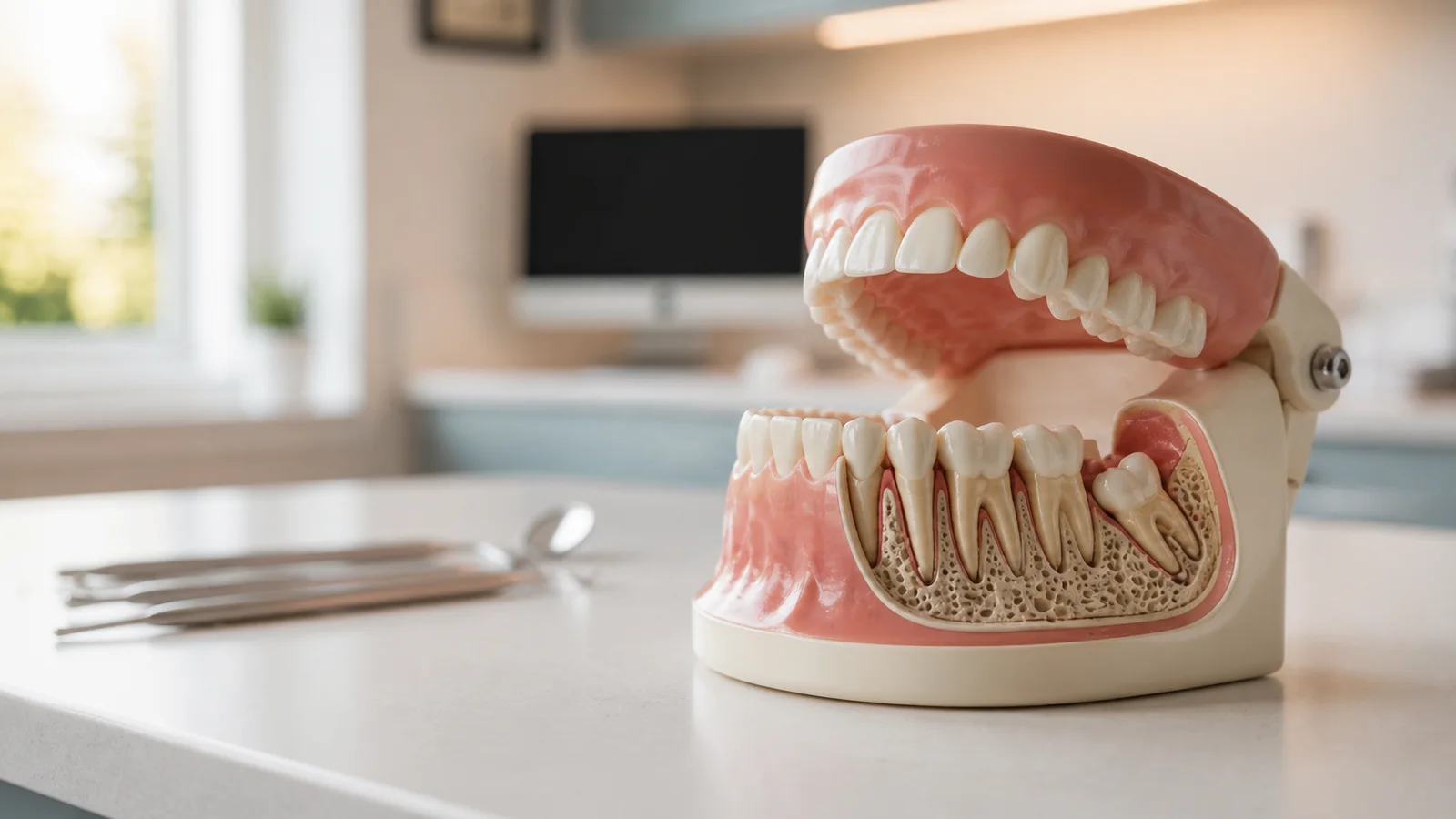
No, not everyone has wisdom teeth. Most people develop four, but it is also normal to have one, two, three, or none. Some people even develop more than four.
There is one important catch: not seeing a wisdom tooth does not mean it is missing. It may still be below the gum, trapped in the jaw, or growing at an angle. The only reliable way to know what you have is a dental exam and an X-ray.
What are wisdom teeth?
Wisdom teeth are your third molars, the last teeth at the very back of the upper and lower jaws. A full set includes four:
- One in the upper right
- One in the upper left
- One in the lower right
- One in the lower left
Most adults have 32 permanent teeth when all four wisdom teeth develop, or 28 when none develop, assuming no other teeth are missing.
They usually emerge after the rest of the adult teeth, most often between ages 17 and 25. This late timing is also why we call them wisdom teeth. The name refers to the old idea that they arrive when a person is becoming older and wiser. The teeth themselves do not add any wisdom.
Why does not everyone have wisdom teeth?
If a wisdom tooth never forms, dentists call it third molar agenesis. That simply means the tooth bud was congenitally absent. You did not lose the tooth, and nothing you ate or did prevented it from growing.
This is common. An updated systematic review and meta-analysis estimates that about one in four people worldwide is missing at least one third molar. Missing all four is less common than missing one or two.
Genetics plays a large role, so the pattern can run in families. Still, your parents' wisdom teeth are not a guarantee of what you will have. You might develop all four even if a parent developed none, or the reverse.
Why do wisdom teeth exist?
Wisdom teeth made more sense for earlier humans than they do for many people today. Our ancestors ate tougher, less processed foods, and their teeth experienced far more wear. An extra molar added useful grinding surface at the back of a larger jaw. It could also help after the first and second molars had become heavily worn.
Modern food is generally softer and easier to prepare. Human jaws and faces have also changed over time. A review in the Journal of the American Dental Association explains that third molars likely had more functional value when human jaws had room for them and teeth played a larger role in survival.
That does not mean wisdom teeth are useless in every modern mouth. A healthy third molar that erupts straight, meets the opposing tooth, and can be cleaned may function like any other molar. The problem is that many mouths do not have enough room for that to happen.
What triggers wisdom teeth to grow?
There is no birthday, food, or hormone surge that suddenly switches wisdom teeth on.
Their development is a slow biological process that starts years before you can see them. The tooth buds usually begin forming during childhood. The crowns and roots then develop gradually inside the jaw. During eruption, the bone and tissues around a tooth remodel so it can move toward the mouth.
Genetics guides much of this timing, while the tooth's angle, available space, and nearby bone or teeth affect whether it can emerge. A wisdom tooth may:
- Erupt fully into a useful position
- Break through only part of the gum
- Remain completely under the gum or bone
- Become impacted against the second molar or the jaw
This is why “growing” and “coming in” are not quite the same thing. A wisdom tooth can develop inside the jaw without ever becoming visible.
When do wisdom teeth come in?
The usual range is 17 to 25 years old, but it is a range, not a deadline. The American Association of Oral and Maxillofacial Surgeons notes that wisdom teeth may take years to erupt fully, if they erupt at all.
Some appear earlier. Others emerge in the late 20s or later. An impacted tooth may stay hidden for years and then become noticeable because the gum around it becomes irritated or infected. That does not always mean the tooth suddenly started growing.
What age do wisdom teeth come in for females?
For females, the same general 17 to 25 range is the most useful guide. Studies sometimes find small timing differences between groups, but there is no separate age at which wisdom teeth are supposed to appear in women.
Individual development matters more than sex alone. A panoramic X-ray gives a much better answer than age charts because it shows whether the teeth exist, how far they have developed, and whether they have a path into the mouth.
Is 26 late for wisdom teeth?
Twenty-six is a little later than the typical range, but it is not automatically a problem. A wisdom tooth can still erupt at 26 or beyond.
What matters is the tooth's position and the health of the surrounding area. If you are 26 and feel pressure or soreness behind your last molar, an X-ray can show whether a wisdom tooth is erupting, partly trapped, or completely impacted. Age alone cannot tell you that.
How to know if you have wisdom teeth
If a third molar has fully erupted, you may be able to see or feel it behind your second molar. Early signs of wisdom teeth coming in can include:
- Tenderness at the very back of the gums
- A small white edge of tooth breaking through
- Red or swollen gum tissue
- Pressure or an ache behind the second molar
- Mild jaw soreness
Those signs are not proof by themselves. The same area can hurt because of a cavity, gum infection, food trapped under the gum, or another dental problem.
You can also have wisdom teeth with no symptoms at all. A tooth may be completely covered by gum and bone, or it may be impacted at an angle where you cannot feel it. A panoramic X-ray is the clearest way to distinguish among three very different situations:
- The wisdom tooth never developed.
- The wisdom tooth is present but has not erupted yet.
- The wisdom tooth is impacted and may not be able to erupt normally.
Do Asians have wisdom teeth?
Yes. Asian people have wisdom teeth.
The more precise answer is that “Asian” covers many genetically and geographically diverse populations. Research has found that the rate of third molar agenesis varies among populations. One large systematic review of more than 63,000 people found substantial geographic differences, with congenitally missing wisdom teeth reported more often in some Asian study populations.
That is a population average, not a rule for an individual. Many Asian people develop all four wisdom teeth. Others develop some or none. The same variation exists within every broad ancestry group, so ethnicity cannot replace an X-ray.
Does everyone have wisdom teeth removed?
No. Having a wisdom tooth does not automatically mean it needs to come out.
A healthy wisdom tooth may be kept if it:
- Erupted into a functional position
- Can be brushed and flossed properly
- Has no decay or gum disease
- Is not damaging the second molar
- Has no cyst or other disease around it
Removal may make sense when there is not enough room, the tooth is difficult to clean, or it is already causing problems. Common reasons include repeated infection around a partly erupted tooth, decay, gum disease, damage to the neighboring molar, or a cyst.
The decision is not simply “remove every wisdom tooth” or “leave every painless tooth alone.” Pain-free does not always mean disease-free, but surgery also has real risks. AAOMS guidance recommends evaluating the tooth's position, function, disease risk, removal risk, and the plan for ongoing monitoring. Teeth associated with disease or a high risk of disease are generally treated surgically. Healthy teeth without significant risk can be watched with clinical exams and X-rays.
What happens if a problematic wisdom tooth is not removed?
Leaving a wisdom tooth in place is not automatically harmful. The concern is a tooth that is impacted, partly erupted, diseased, or damaging the second molar. Without treatment, a problematic wisdom tooth may lead to:
- Repeated infection around a flap of gum tissue
- Decay in the wisdom tooth or the neighboring second molar
- Gum disease and bone loss behind the second molar
- Damage to the root or supporting structures of the neighboring tooth
- A cyst or another change in the tissue around an impacted tooth
Some of these problems can develop without obvious pain. That is why a wisdom tooth being monitored still needs periodic dental exams and X-rays. When a tooth remains healthy and the risks of surgery outweigh the current disease risk, continued monitoring may still be the right plan.
When to have the area checked
Arrange a dental evaluation if you notice:
- Pain or swelling behind your last molar
- Red, bleeding, or very tender gums
- A bad taste or persistent bad breath
- Difficulty opening your mouth
- Food repeatedly catching beneath a gum flap
- Fever or feeling unwell along with dental pain
- Pressure that is new or getting worse
These symptoms can point to infection or another problem that should not be diagnosed at home. Severe swelling, trouble swallowing, or trouble breathing needs urgent medical attention.
What happens if removal is recommended?
If an exam and X-ray show that removal is the safer option, the next step is a consultation to review which teeth need treatment, how they are positioned, anesthesia choices, and the expected recovery. Our wisdom teeth removal page explains the treatment in more detail.
After surgery, your discharge instructions should guide your recovery. You can also review our general post-operative instructions and our guide to what to eat after a tooth extraction.
The short answer
Does everyone have wisdom teeth? No. Four is the usual number, but fewer than four or none at all can be completely normal. Wisdom teeth usually come in between 17 and 25, although later eruption is possible. Your ancestry, age, and symptoms can offer clues, but only an exam and X-ray can show whether the teeth are absent, still developing, or impacted.
If you want a clear answer about your own wisdom teeth, schedule an evaluation with our Trumbull oral surgery team. We can review an X-ray, explain what each tooth is doing, and help you decide whether wisdom teeth removal or continued monitoring makes more sense.